


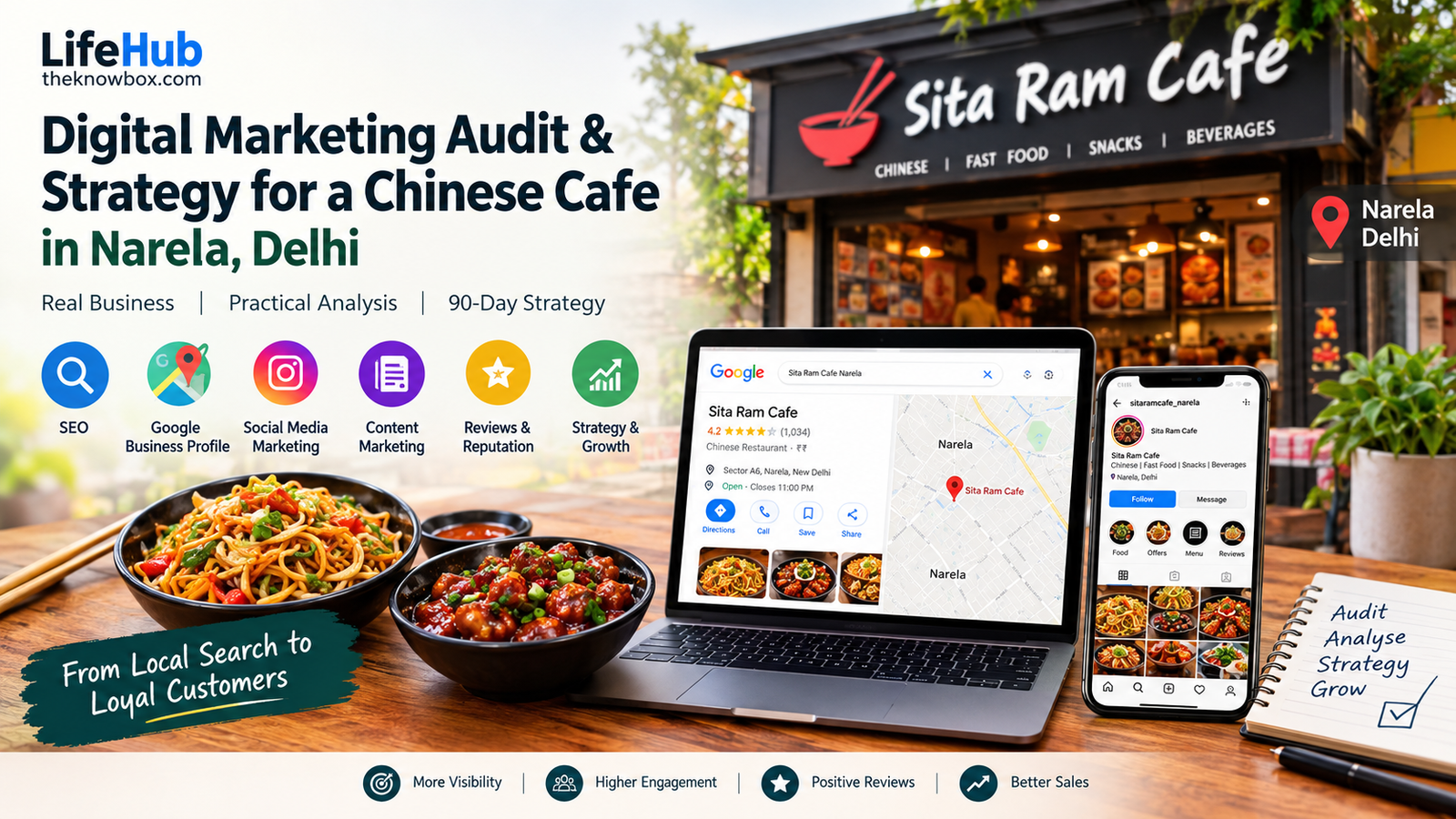
Digital marketing has become an important part of how local businesses attract and retain customers. For restaurants and cafés, customers often search online before deciding where to eat. They may check Google Maps, reviews, photos, menus, Instagram pages, offers, and customer feedback before making a decision.
This makes digital marketing especially important for local cafés that want to attract customers from their surrounding area.
In this practical case study, I have applied digital marketing concepts to a real local business, Sita Ram Cafe in Narela, Delhi, with a focus on its Chinese and fast-food offerings.
The purpose of this project is to understand how a local café can use Local SEO, Google Business Profile, Social Media Marketing, Content Marketing, Reviews, Competitor Analysis and Digital Marketing Strategy to improve its online presence.
Note: This is an educational and portfolio project based on publicly available information. It is not an official audit conducted using the café’s internal business or marketing data.
About the Business
For this case study, I selected Sita Ram Cafe, Narela, Delhi.
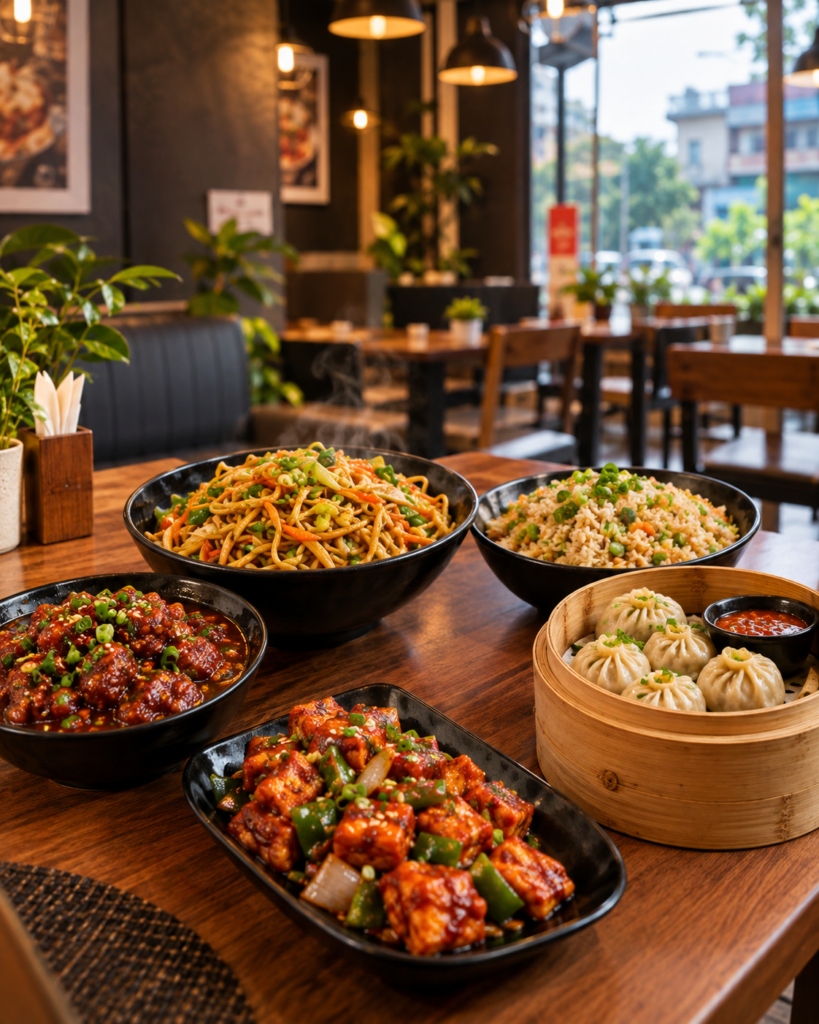
The café is located in Sector A6, Narela, New Delhi. Its online food listings show a range of fast-food and Chinese-style dishes including Hakka Noodles, Garlic Noodles, Fried Rice, Manchurian, Chilli Paneer and other food options.
This makes it a suitable example for understanding how digital marketing can be applied to a local food business.
Business Overview
| Business Element | Details |
|---|---|
| Business Name | Sita Ram Cafe |
| Location | Sector A6, Narela, Delhi |
| Business Type | Local Cafe / Fast Food |
| Food Focus | Chinese & Fast Food |
| Target Area | Narela and nearby areas |
| Target Customers | Students, young adults, families and local residents |
| Audit Type | Digital Marketing Audit |
| Project Type | Educational / Portfolio Case Study |
Project Objective
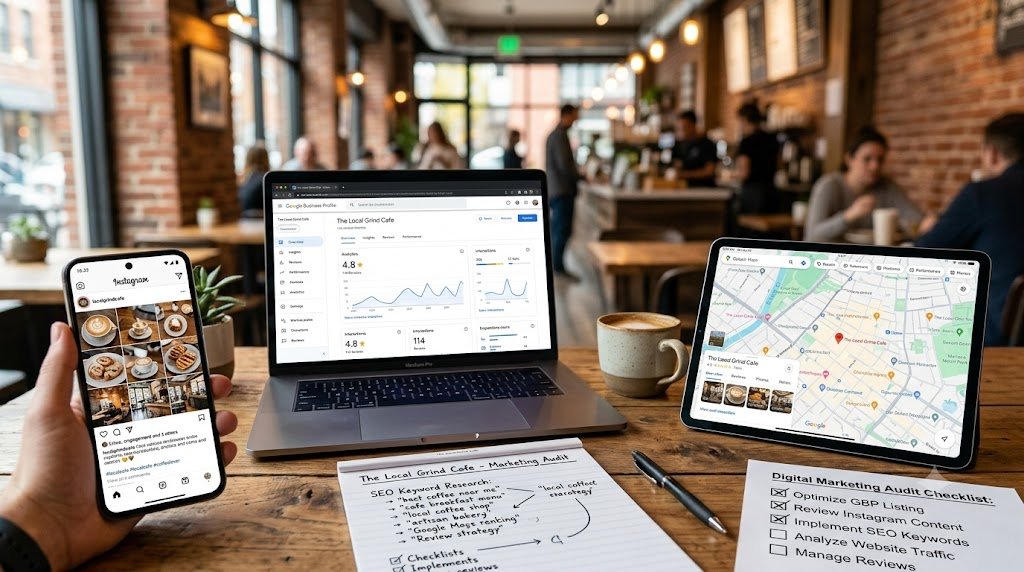
The main objective of this project is to conduct a practical digital marketing audit of a local café and develop a strategy that can help improve its online visibility and customer engagement.
The key objectives are:
- To analyse the café’s online presence.
- To audit its Google Business Profile.
- To identify local SEO opportunities.
- To analyse social media marketing opportunities.
- To understand the customer journey.
- To identify content marketing opportunities.
- To analyse local competitors.
- To identify strengths and weaknesses.
- To create a digital marketing funnel.
- To develop a 90-day digital marketing strategy.
- To define measurable KPIs.
- To understand how digital marketing theory can be applied to a real business.
Why Digital Marketing Is Important for a Local Cafe
Imagine a customer in Narela searching on Google:
“Chinese food near me”
or
“Best Chinese food in Narela”
The customer may see several restaurants and cafés.
Before choosing one, the customer may look at:
- Google rating
- Reviews
- Food photos
- Menu
- Location
- Prices
- Instagram content
- Offers
- Customer experiences
Therefore, simply having a physical café is not enough.
A local business needs to be visible, trustworthy and easy to choose online.
The customer journey can be represented as:
Search → Discover → Compare → Trust → Visit/Order → Review → Repeat
This is where digital marketing becomes valuable.
Digital Marketing Audit Checklist
Before creating a strategy, it is important to understand the current digital presence of the business.
| Audit Area | What Should Be Checked |
|---|---|
| Google Business Profile | Name, category, address, phone |
| Google Reviews | Rating, reviews and responses |
| Photos | Food, interior, exterior and menu |
| Menu | Online menu availability |
| Website | Availability and usability |
| Local SEO | Location-based keywords |
| Profile, bio and content | |
| Page and activity | |
| Content | Reels, posts and offers |
| Competitors | Local competitors |
| Customer Journey | Search to conversion |
| CTA | Call, directions and order |
| Analytics | Tracking and measurement |
1. Google Business Profile Audit
Google Business Profile is one of the most important digital assets for a local café.
When customers search for a restaurant or café nearby, Google Maps and local search results can influence their decision.
The following elements should be checked:
- Business name
- Primary category
- Address
- Phone number
- Opening hours
- Website
- Menu
- Ordering options
- Photos
- Reviews
- Review responses
- Google Posts
- Questions and answers
- Location accuracy
For a local café, the profile should provide enough information for a customer to make a decision without unnecessary searching.
Recommended Google Business Profile Strategy
The café should focus on:
Accurate Information + Updated Menu + High-Quality Photos + Reviews + Regular Posts + Clear CTAs
Google Post Ideas
- Today’s Chinese Special
- Hakka Noodles Special
- Chilli Paneer Special
- Weekend Food Combo
- Student Food Offer
- Family Combo
- New Menu Item
- Customer Favourite
- Special Discount
- Festival Offer
2. Local SEO Audit
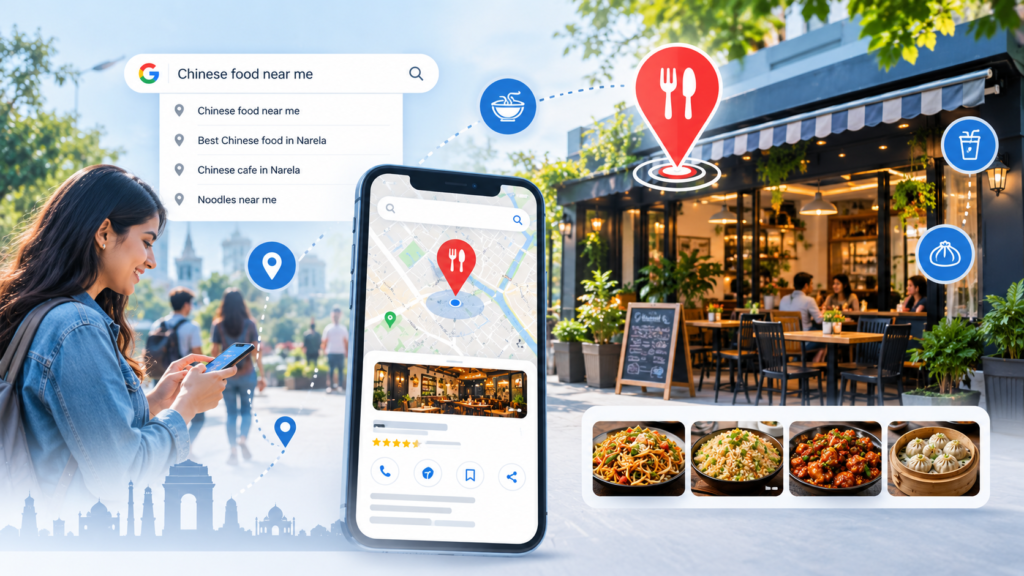
Local SEO helps businesses become more visible when customers search for products or services in a specific geographical area.
For a café in Narela, location-based keywords are particularly important.
Potential Local SEO Keywords
| Keyword | Search Intent |
|---|---|
| Chinese food in Narela | Commercial |
| Chinese cafe in Narela | Commercial |
| Chinese food near Narela | Commercial |
| Best noodles in Narela | Commercial |
| Fast food in Narela | Commercial |
| Cafe in Narela | Commercial |
| Chinese restaurant near Narela | Commercial |
| Veg Chinese food Narela | Commercial |
| Affordable Chinese food Narela | Commercial |
| Noodles near me | Local |
These keywords should be used naturally in relevant places such as:
- Website content
- Blog posts
- Menu pages
- Google Business Profile posts
- Image alt text
- FAQs
- Social media captions
- Local landing pages
Keyword stuffing should be avoided because the goal is to create useful content for customers rather than simply repeating keywords.
3. Website Audit
A dedicated website can give a café more control over its online customer journey.
If a website is available or created, it should contain clear and useful information.
Homepage
The homepage should include:
- Café name
- Location
- Main food categories
- Popular dishes
- High-quality food images
- Customer reviews
- Clear CTA buttons
Menu Page
The menu can be divided into categories such as:
- Chinese
- Noodles
- Fried Rice
- Manchurian
- Chilli Paneer
- Snacks
- Beverages
Location Page
The location page should include:
- Narela
- Sector A6
- Complete address
- Google Maps
- Opening hours
- Contact information
Contact / Order Section
Clear CTA buttons can include:
Call Now
Get Directions
Order Now
WhatsApp Us
A simple customer journey can reduce friction and make it easier for visitors to take action.
4. Social Media Audit
Food is highly visual, which makes social media an important marketing channel for cafés.
Instagram can be used to showcase food, offers, customer experiences and behind-the-scenes content.
Instead of only posting promotional content, the café should create content that makes people interested in the food and the experience.
Recommended Content Pillars
| Content Pillar | Example |
|---|---|
| Food | Hakka Noodles Reel |
| Behind the Scenes | Cooking Process |
| Offers | Weekend Combo |
| Customer Experience | Customer Reaction |
| Educational | Food Facts |
| Local Content | Narela Food Content |
| Engagement | Food Poll |
| Trending Content | Trending Reel |
Recommended Content Mix
| Content Type | Percentage |
|---|---|
| Food Content | 40% |
| Offers | 20% |
| Behind the Scenes | 15% |
| Customer Content | 15% |
| Educational / Interactive | 10% |
5. Content Marketing Strategy
One of the biggest opportunities for a local café is to turn its food products into engaging content.
For example, instead of posting:
Hakka Noodles Available
the café can create a Reel around:
POV: You were craving Chinese food and found your new favourite noodles in Narela.
This creates a story around the product.
Content Ideas
- POV: You’re craving Chinese food after college.
- Hakka Noodles vs Fried Rice – Which one wins?
- 3 Chinese dishes to try.
- Behind the scenes of making Chilli Paneer.
- What to order for two people?
- Budget-friendly Chinese food ideas.
- Customer favourite of the week.
- Rate this food from 1–10.
- Narela food lovers, save this place.
- What is your favourite Chinese dish?
The objective should be to create content that people want to watch, save, share and discuss.
6. Online Review Strategy
Reviews are an important part of the customer decision-making process.
A customer may compare restaurants based on their ratings, reviews and customer experiences.
Therefore, a café should have a systematic review strategy.
Recommended Review Process
Good Customer Experience
↓
Ask for Feedback
↓
Provide Google Review Option
↓
Customer Leaves Review
↓
Business Responds
↓
Builds Social Proof
A QR code can also be placed near the billing counter to make it easier for customers to find the review page.
Positive Review Strategy
For positive reviews, the business should:
- Thank the customer.
- Mention their feedback.
- Invite them to visit again.
Negative Review Strategy
For negative reviews, the business should:
- Acknowledge the concern.
- Respond politely.
- Avoid arguments.
- Offer to resolve the issue privately where appropriate.
The objective is not to hide negative feedback but to demonstrate professional customer service.
7. Competitor Analysis
A local café does not operate in isolation.
Customers can choose from several restaurants, cafés and fast-food outlets in the same area.
Competitor analysis helps identify what other businesses are doing well and where opportunities exist.
Competitor Analysis Framework
| Factor | Sita Ram Cafe | Competitor 1 | Competitor 2 |
|---|---|---|---|
| Google Presence | Audit | Audit | Audit |
| Reviews | Record | Record | Record |
| Chinese Menu | Check | Check | Check |
| Check | Check | Check | |
| Reels | Check | Check | Check |
| Offers | Check | Check | Check |
| Menu Visibility | Check | Check | Check |
| Local SEO | Check | Check | Check |
| Customer Engagement | Check | Check | Check |
The competitor names and live numbers should be filled in after conducting the actual Google and Instagram research.
8. SWOT Analysis
A SWOT analysis helps understand the internal and external factors affecting a business.
Strengths
- Local physical presence.
- Narela location.
- Multiple food options.
- Chinese-style food offerings.
- Online food-platform presence.
- Opportunity for visual food content.
Weaknesses
- Strong competition in the local market.
- Possible dependence on third-party food platforms.
- Limited control over third-party customer journeys.
- Opportunity to improve consistent digital content.
- Opportunity to strengthen local SEO.
Opportunities
- Google Business Profile optimization.
- Local SEO.
- Instagram Reels.
- Food photography.
- Review generation.
- WhatsApp communication.
- Local influencer collaborations.
- Student-focused offers.
- Hyperlocal advertising.
Threats
- Local competitors.
- Price competition.
- Changing customer preferences.
- Negative reviews.
- Competition on food delivery platforms.
- Competitors with stronger social media content.
9. Target Audience
A local café can target different customer groups.
| Audience | Customer Need | Recommended Content |
|---|---|---|
| Students | Affordable food | Student combos |
| Young Adults | Taste & experience | Reels & trends |
| Families | Variety & value | Family combos |
| Local Residents | Convenience | Location & offers |
Primary Customer Persona
Local Food Explorer
Age: 18–30 years
Location: Narela and nearby areas
Behaviour: Uses Google, Instagram and food-delivery platforms.
Needs: Affordable, tasty and convenient food.
Decision Factors:
- Reviews
- Photos
- Menu
- Price
- Location
- Recommendations
- Offers
Understanding this audience helps create more relevant content and advertisements.
10. Digital Marketing Funnel for the Cafe

The digital marketing funnel explains how a person moves from discovering the business to becoming a customer.
Awareness
Instagram Reels + Google Search + Local Content
↓
Consideration
Food Photos + Menu + Reviews + Offers
↓
Conversion
Call + Directions + Order + Visit
↓
Retention
Reviews + Offers + Customer Communication + Repeat Visits
The complete journey can look like:
Instagram Reel
↓
Google Search
↓
Google Business Profile
↓
Menu
↓
Customer Visit / Order
↓
Google Review
↓
Repeat Offer
This practical example shows how the digital marketing funnel can be applied to a real local business.
11. Recommended Digital Marketing Strategy
Based on the audit, the recommended strategy should focus on five major areas.

1. Local SEO
Improve visibility for searches related to:
- Chinese food
- Cafés
- Fast food
- Noodles
- Narela
- Nearby searches
2. Social Media Marketing
Focus on:
- Instagram Reels
- Food photography
- Stories
- Customer content
- Offers
- Local content
3. Review Management
Create a consistent process for:
- Requesting reviews
- Responding to reviews
- Monitoring customer feedback
- Improving customer experience
4. Content Marketing
Create content around:
- Food
- Offers
- Behind-the-scenes
- Customers
- Local area
- Food education
- Trends
5. Paid Advertising
After establishing basic tracking and content consistency, small location-based Meta advertising campaigns can be tested.
The campaigns can focus on customers within the relevant local area.
12. 90-Day Digital Marketing Action Plan
A 90-day plan can help convert the strategy into practical activities.
| Period | Activity | Objective |
|---|---|---|
| Days 1–15 | Google Business Profile Audit | Improve local presence |
| Days 1–15 | Competitor Research | Identify opportunities |
| Days 1–20 | Keyword Research | Identify local keywords |
| Days 15–30 | Content Calendar | Build consistency |
| Days 15–30 | Food Photography | Improve visual content |
| Days 20–45 | Review Strategy | Increase social proof |
| Days 30–60 | Instagram Reels | Increase awareness |
| Days 30–60 | Local SEO Content | Improve discovery |
| Days 45–75 | Local Paid Campaign | Test customer acquisition |
| Days 60–90 | Performance Analysis | Identify winning content |
| Days 75–90 | Strategy Optimization | Improve performance |
13. Social Media Content Calendar
A simple weekly content calendar can maintain consistency.
| Day | Platform | Content | Funnel Stage |
|---|---|---|---|
| Monday | Food Reel | Awareness | |
| Tuesday | Business Post | Awareness | |
| Wednesday | Food Photo | Consideration | |
| Thursday | Poll / Question | Engagement | |
| Friday | Offer Reel | Conversion | |
| Saturday | Customer Content | Trust | |
| Sunday | Instagram + Google | Weekly Special | Conversion |
Consistency is more important than posting randomly.
14. Key Performance Indicators (KPIs)
A digital marketing strategy should always be measurable.
Google Business Profile KPIs
- Search views
- Profile views
- Calls
- Direction requests
- Website clicks
- Menu clicks
- Review growth
Instagram KPIs
- Reach
- Reel views
- Engagement
- Saves
- Shares
- Profile visits
- Followers
- CTA actions
Business KPIs
- Orders
- Walk-ins
- Repeat customers
- Reviews
- Average order value
- Customer acquisition cost
- Return on ad spend
These metrics can help determine which activities are producing meaningful results.
15. Recommended Budget Allocation
A small local business should start with a controlled marketing budget and increase spending after identifying what works.
An example allocation could be:
| Activity | Suggested Budget Share |
|---|---|
| Content Creation | 25% |
| Meta Ads | 30% |
| Local SEO | 20% |
| Photography & Design | 15% |
| Testing | 10% |
This is an example framework rather than a fixed recommendation.
The actual budget should depend on the café’s goals, resources and campaign performance.
16. Expected Outcomes
A consistent digital marketing strategy can aim to improve:
- Local search visibility
- Brand awareness
- Instagram reach
- Customer engagement
- Review generation
- Menu visits
- Calls
- Direction requests
- Food orders
- Repeat customer opportunities
However, these should be treated as target outcomes rather than guaranteed results.
Actual performance depends on factors such as competition, budget, content quality, execution, seasonality and customer behaviour.
17. Key Recommendations
Based on this practical audit, the major recommendations are:
- Optimize the Google Business Profile.
- Keep business information accurate and consistent.
- Upload high-quality food photographs.
- Keep the digital menu updated.
- Develop a systematic Google review strategy.
- Post Instagram Reels consistently.
- Create Narela-focused content.
- Promote specific signature dishes.
- Use clear CTAs.
- Track calls, directions, orders and reviews.
- Test small local advertising campaigns.
- Review performance every month.
- Continue improving the strategy based on data.
18. The Complete Digital Marketing Framework
The entire strategy can be simplified into six steps:
AUDIT
Understand the current digital presence.
↓
OPTIMIZE
Improve profiles, SEO, menu and customer journey.
↓
CREATE
Create useful, attractive and engaging content.
↓
PROMOTE
Use organic and paid marketing channels.
↓
MEASURE
Track KPIs and customer actions.
↓
IMPROVE
Use performance data to optimize the next campaign.
AUDIT → OPTIMIZE → CREATE → PROMOTE → MEASURE → IMPROVE
19. Key Learnings From This Project
This project helped me understand that digital marketing is not simply about posting content on social media.
A successful digital marketing strategy requires understanding:
- The business
- The target audience
- Competitors
- Search behaviour
- Customer journey
- Content
- Conversion
- Reviews
- Analytics
- Continuous optimization
The most important learning from this project is that even a small local business can have multiple digital touchpoints.
Google can help customers discover the business.
Instagram can create awareness.
Reviews can build trust.
The menu can support consideration.
Calls, directions and orders can create conversion.
Reviews and offers can help with retention.
Conclusion
A local café does not necessarily need a huge marketing budget to build a strong digital presence.
It needs to become easy to discover, easy to trust and easy to choose.
For a Chinese and fast-food café in Narela, a practical digital marketing strategy should connect:
Local SEO + Google Business Profile + Instagram + Content Marketing + Reviews + Customer Journey + Analytics
The complete journey can be represented as:
Search → Discover → Trust → Visit/Order → Review → Repeat
This case study helped me understand how theoretical concepts such as Digital Marketing Strategy, Local SEO, Social Media Marketing, Content Marketing, Competitor Analysis, Digital Marketing Funnel and KPIs can be applied to a real local business.
It also demonstrates how a digital marketer can move beyond theory and create a practical strategy based on research, observation and measurable objectives.
Frequently Asked Questions
What is a digital marketing audit for a cafe?
A digital marketing audit evaluates a café’s online presence across search engines, Google Business Profile, social media, website, reviews, content and other digital channels.
Why is local SEO important for a cafe?
Local SEO helps a café become more visible when nearby customers search for restaurants, cafés or specific food items.
Which social media platform is useful for a cafe?
Instagram can be particularly useful because food is highly visual and can be promoted through photos, Reels and Stories.
How can a cafe get more Google reviews?
A café can politely request feedback from satisfied customers and make the process easy through a QR code or direct review link.
What are important KPIs for restaurant digital marketing?
Important KPIs include Google searches, calls, direction requests, menu clicks, social reach, engagement, reviews, orders and repeat customers.
How long does a digital marketing strategy take to show results?
The timeline depends on the marketing channel, competition, budget and execution. Organic SEO and content generally require consistency, while paid campaigns can provide performance data more quickly.
Disclaimer
This case study has been created for educational and portfolio purposes. The audit is based on publicly available digital information and does not represent an official audit commissioned by or conducted using the internal marketing data of Sita Ram Cafe.