

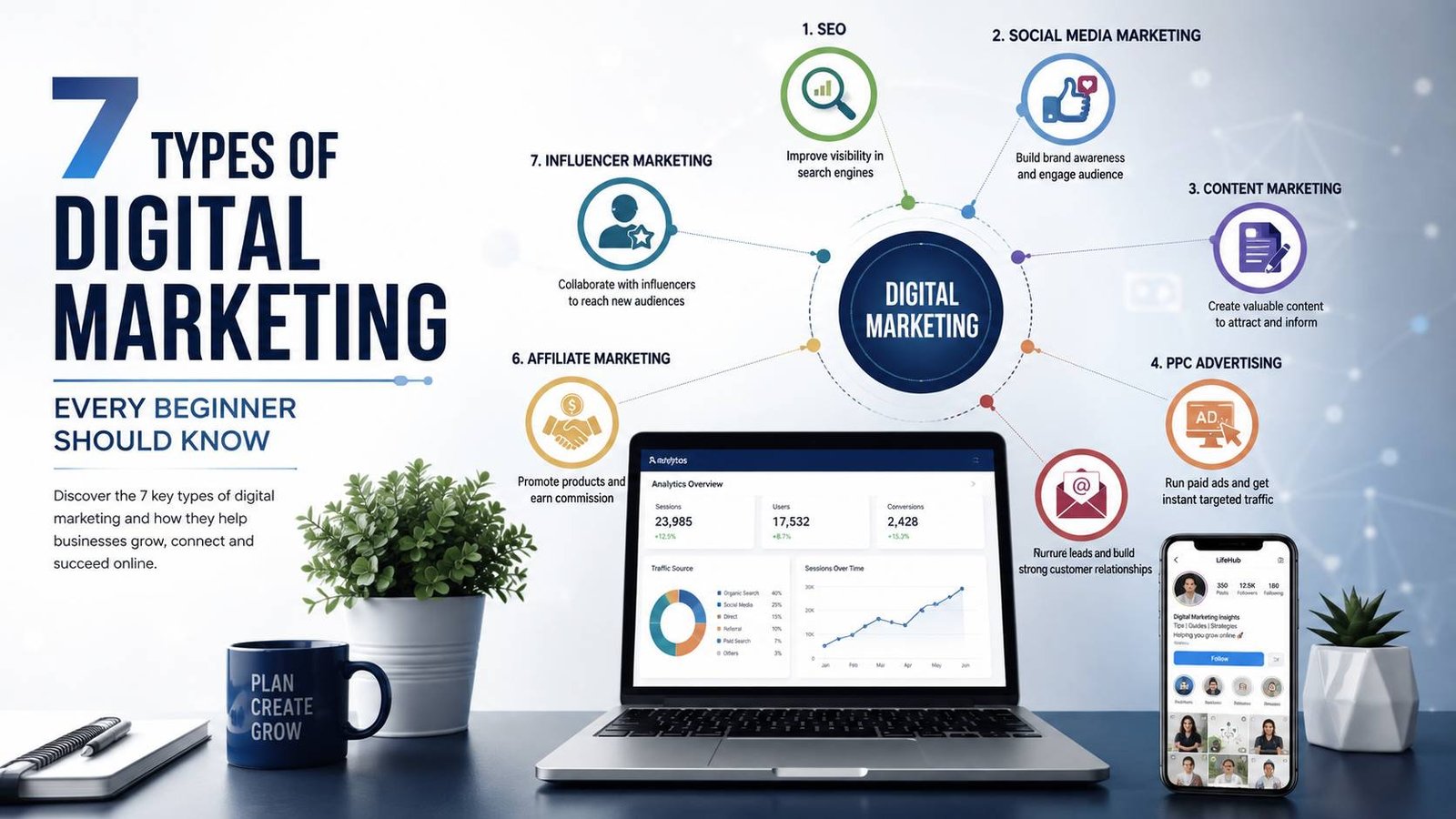
Digital marketing has become one of the most important ways for businesses to reach people, build their brands, and generate customers online. Whether you see a Google search result, an Instagram Reel, a YouTube advertisement, an email from a brand, or a helpful blog post, there is a good chance that digital marketing is involved.
But digital marketing is not just one activity. It includes several different channels, and each channel has a different purpose.
If you are a beginner, understanding these different types can help you decide what to learn first and how different marketing activities work together.
In this guide, we will explore the 7 major types of digital marketing with simple explanations, examples, benefits, and beginner-friendly tips. A Beginner’s Guide to Understanding Digital Marketing
What Are the Different Types of Digital Marketing?
Digital marketing refers to promoting products, services, brands, or ideas through digital channels such as search engines, websites, social media platforms, email, and online advertising.
The seven types covered in this guide are:
- Search Engine Optimization (SEO)
- Social Media Marketing (SMM)
- Content Marketing
- Pay-Per-Click Advertising (PPC)
- Email Marketing
- Affiliate Marketing
- Influencer Marketing
These channels do not always work separately. A strong digital marketing strategy often combines several of them so that one channel can support another.
1. Search Engine Optimization (SEO)
Search Engine Optimization, commonly called SEO, is the process of improving a website or webpage so that it can appear more prominently in organic search results.
For example, imagine someone searches Google for:
“Best digital marketing tips for beginners”
If your blog is well-optimized and provides useful information, it may appear in the search results.
The goal of SEO is not simply to get visitors. It is to attract people who are actually searching for information, products, or services related to your topic.
How Does SEO Work?
SEO involves several activities, including:
- Keyword research
- Creating useful content
- Optimizing page titles and headings
- Improving website structure
- Using relevant internal links
- Optimizing images
- Improving page experience
- Building trustworthy references and links
SEO can take time because search visibility usually develops gradually, but it can become a valuable long-term source of organic traffic.
Simple Example
Suppose you have a website about digital marketing.
You publish an article targeting the topic:
“How to Create a Social Media Strategy”
You optimize the content around relevant search intent, create clear headings, provide useful information, and connect it with related articles on your website.
Over time, people searching for that information may discover your article through search engines.
Why Is SEO Important?
SEO can help businesses:
- Increase organic visibility
- Attract relevant visitors
- Build credibility
- Support long-term traffic growth
- Make useful content easier to discover
Beginner Tip
If you are learning digital marketing, SEO is one of the best areas to practice because you can experiment on your own website or blog.
2. Social Media Marketing (SMM)
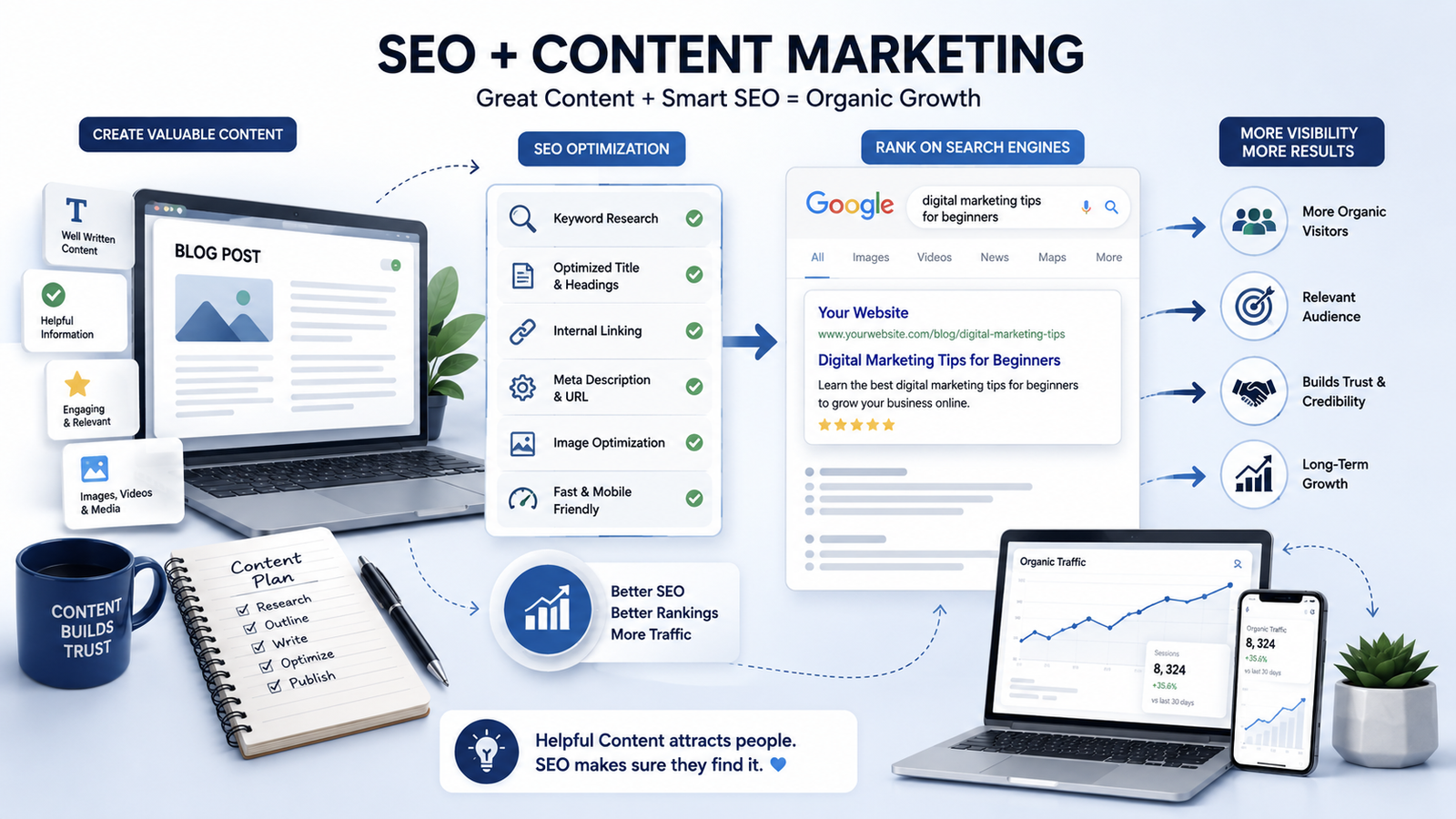
Social Media Marketing is the use of social media platforms to build awareness, engage audiences, distribute content, and support business goals.
Platforms can include Instagram, Facebook, LinkedIn, YouTube, Pinterest, and X, depending on where the target audience spends time.
Social media marketing is more than simply posting every day.
A good social media strategy considers:
- Target audience
- Content pillars
- Platform selection
- Posting consistency
- Creative formats
- Captions and CTAs
- Community engagement
- Performance analysis
Simple Example
Imagine a small clothing brand.
It could use Instagram to:
- Share product Reels
- Post styling ideas
- Show behind-the-scenes content
- Share customer reviews
- Run promotional campaigns
- Respond to comments and messages
The objective is to create awareness and relationships while eventually encouraging people to take action.
Why Is Social Media Marketing Important?
Social media can help brands:
- Increase brand awareness
- Communicate directly with audiences
- Build communities
- Distribute content
- Collect audience feedback
- Generate leads and conversions
Beginner Tip
Do not try to master every platform at once.
Start with one platform, understand its audience and content formats, and learn how to measure performance.
3. Content Marketing
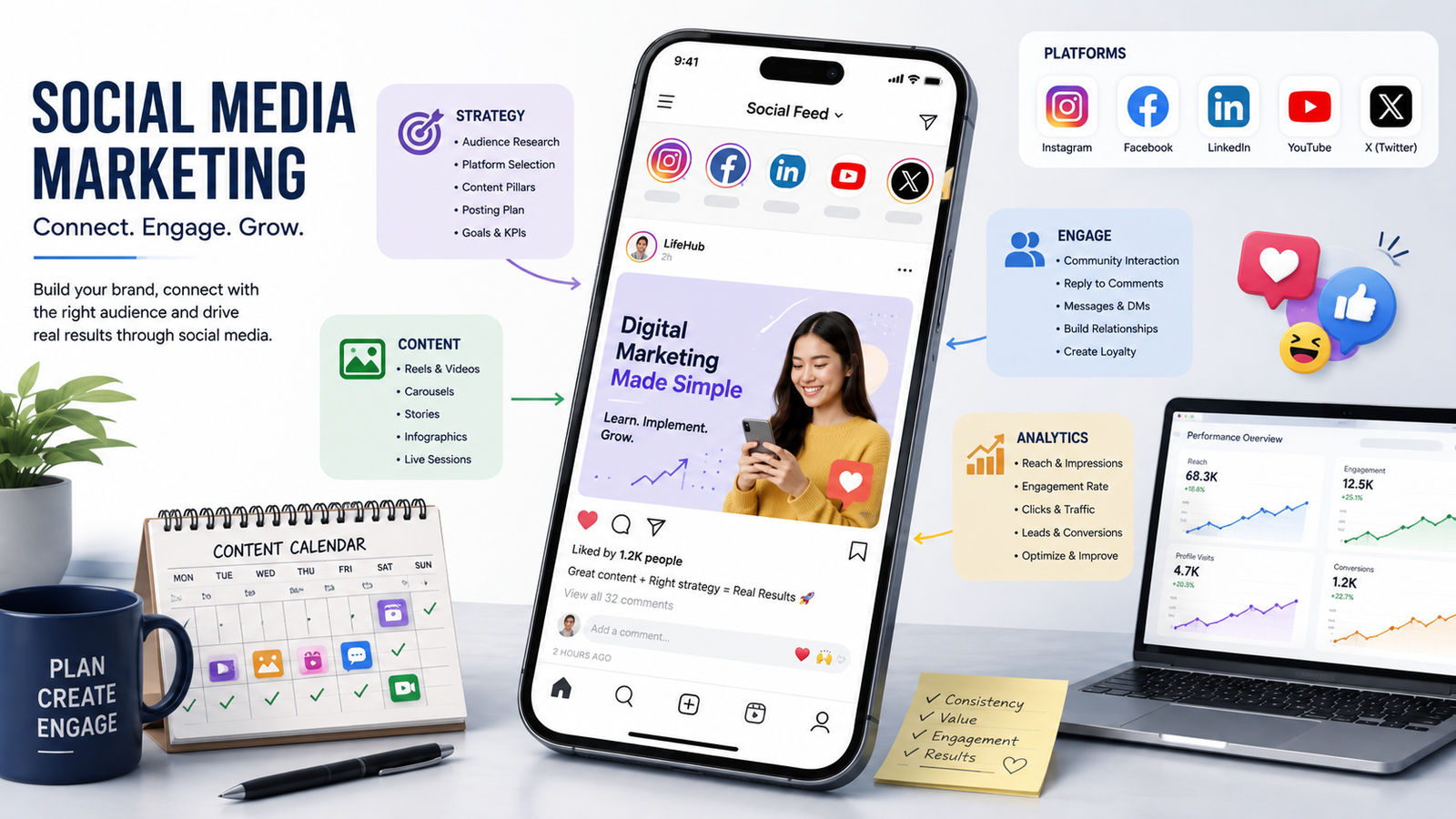
Content Marketing is the process of creating and distributing useful, relevant, and valuable content to attract and engage a specific audience.
Content can take many forms, including:
- Blog posts
- Articles
- Videos
- Infographics
- Guides
- Case studies
- Social media posts
- Ebooks
- Newsletters
The main idea is simple:
Instead of constantly asking people to buy, provide useful information that helps them first.
Simple Example
Suppose you run a digital marketing website.
Instead of only publishing promotional content, you could create articles such as:
- What Is Digital Marketing?
- Types of Digital Marketing
- How SEO Works
- How to Create a Social Media Strategy
- Common Digital Marketing Mistakes
These articles can educate your audience and help establish your website as a useful resource.
Why Is Content Marketing Important?
Content marketing can help:
- Build trust
- Educate audiences
- Support SEO
- Generate organic traffic
- Establish expertise
- Support social media and email campaigns
Beginner Tip
Focus on helpfulness rather than content quantity.
One genuinely useful article can be more valuable than several short pieces that do not answer the reader’s question.
4. Pay-Per-Click Advertising (PPC)
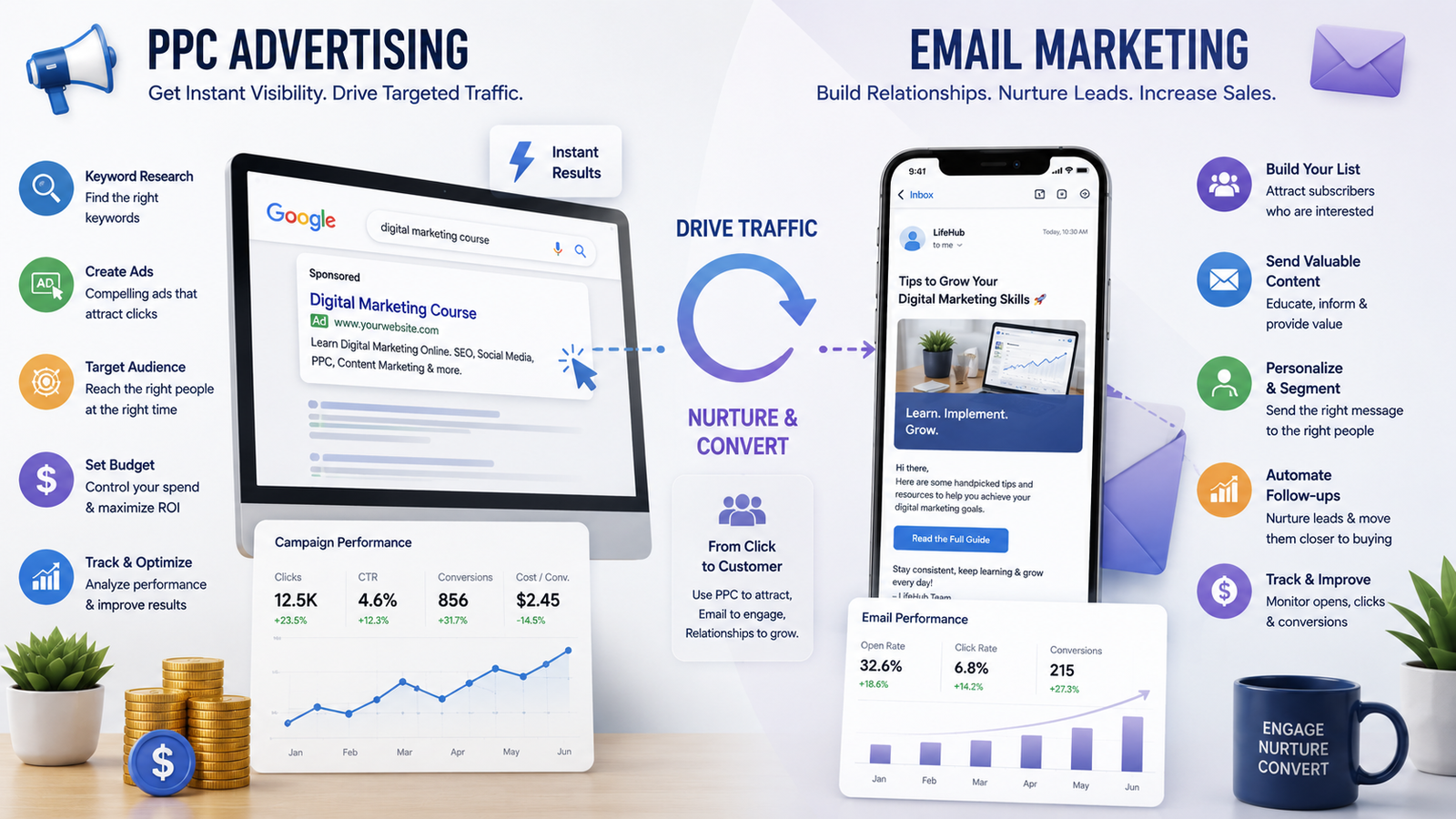
Pay-Per-Click advertising is a form of paid digital advertising where advertisers generally pay when someone clicks on their advertisement.
You may see PPC ads when searching on Google or while browsing other digital platforms.
For example, if a company sells online courses, it might create an advertisement targeting people searching for terms related to those courses.
How Does PPC Work?
A basic PPC campaign usually involves:
- Choosing a goal
- Identifying the target audience
- Selecting keywords or targeting criteria
- Creating advertisements
- Setting a budget
- Sending users to a relevant landing page
- Measuring results
Simple Example
Imagine a digital marketing institute wants more students.
It could run a Google Ads campaign targeting searches related to:
“digital marketing course”
When relevant users see the advertisement and click it, they can be directed to a course landing page.
Why Is PPC Important?
PPC can help businesses:
- Reach targeted audiences
- Generate traffic quickly
- Promote specific products or services
- Test marketing messages
- Measure campaign performance
However, PPC requires careful budget management and continuous optimization.
Beginner Tip
Before spending real money, understand important metrics such as:
- Click-through rate (CTR)
- Cost per click (CPC)
- Conversion rate
- Cost per conversion
- Return on ad spend (ROAS)
5. Email Marketing
Email Marketing involves using email to communicate with prospects, customers, subscribers, or other audiences.
It can be used for:
- Newsletters
- Product updates
- Offers
- Educational content
- Welcome emails
- Customer follow-ups
- Lead nurturing
Simple Example
Imagine someone visits your website and subscribes to your newsletter.
You could send them:
Email 1: Welcome to the newsletter
Email 2: Beginner’s guide to digital marketing
Email 3: SEO tips for beginners
Email 4: Recommended resources
This creates an ongoing communication channel with the audience.
Why Is Email Marketing Important?
Email marketing can help businesses:
- Build relationships
- Nurture leads
- Retain customers
- Share personalized information
- Drive repeat visits
- Promote products and services
Beginner Tip
Do not send emails simply because you can.
Focus on providing something useful to subscribers and use clear subject lines and calls to action.
6. Affiliate Marketing
Affiliate Marketing is a performance-based marketing method where individuals or organizations promote another company’s products or services and may earn a commission when their referral generates a qualifying action, such as a sale.
How Does Affiliate Marketing Work?
The basic process is:
Brand → Affiliate → Audience → Action → Commission
For example, a blogger may write an article reviewing a product.
The article contains a special affiliate link.
If a reader uses that link and makes a qualifying purchase, the affiliate may receive a commission according to the program’s terms.
Simple Example
Suppose a technology blogger creates:
“Best Budget Laptops for Students”
The blogger discusses several products and includes affiliate links.
A reader clicks one of the links and purchases a laptop.
The blogger may earn a commission from that referral.
Why Is Affiliate Marketing Important?
Affiliate marketing can help:
- Brands expand their reach
- Creators monetize useful content
- Businesses acquire customers through partners
- Marketers work with performance-based models
Beginner Tip
Trust is extremely important.
Only recommend products or services that are genuinely relevant to your audience, and clearly disclose affiliate relationships where required.
7. Influencer Marketing
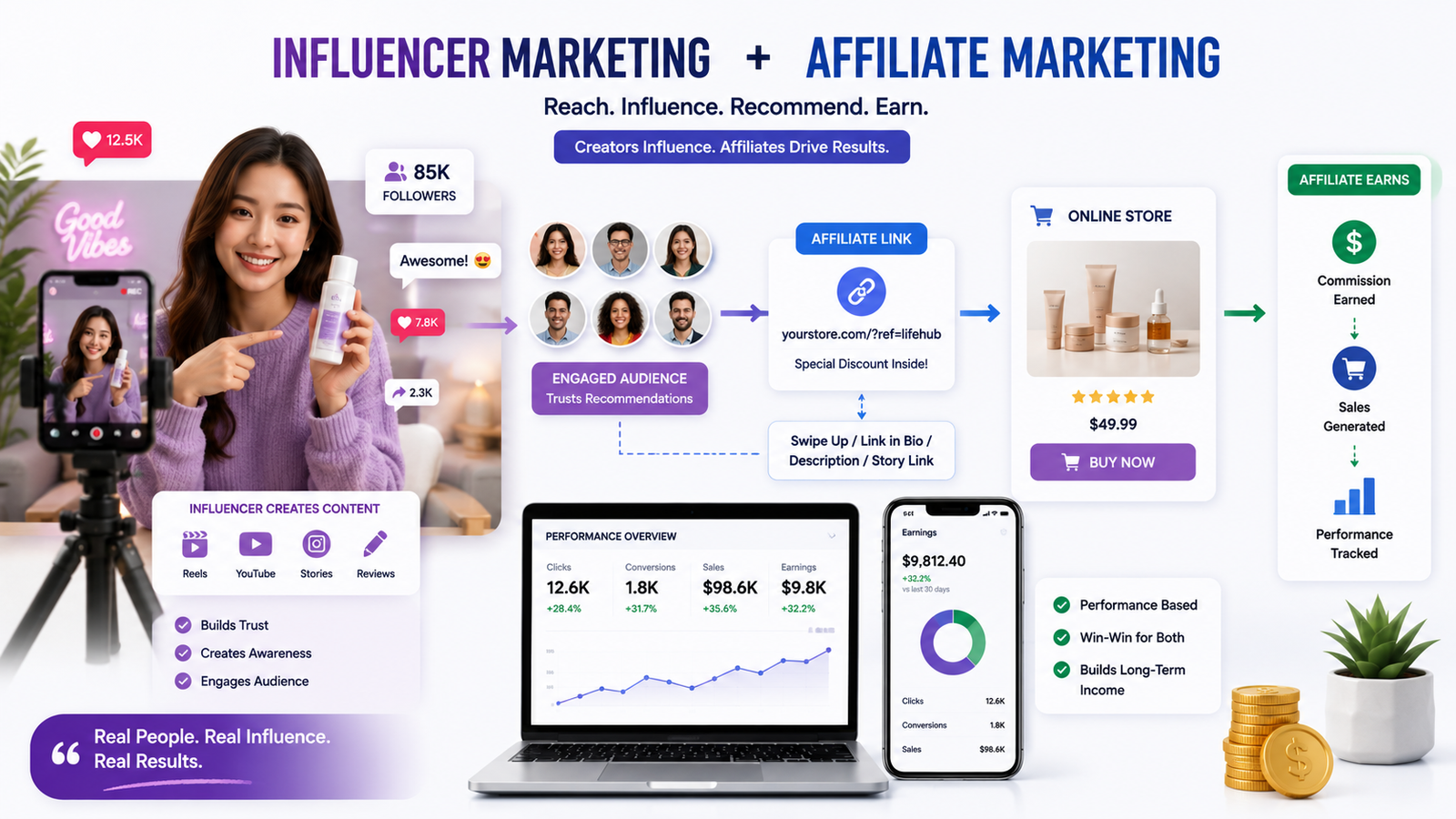
Influencer Marketing is a form of digital marketing where brands collaborate with creators or influencers who have an engaged audience.
Influencers can create:
- Instagram Reels
- YouTube videos
- Product reviews
- Tutorials
- Stories
- Sponsored posts
- Educational content
Simple Example
Imagine a skincare brand wants to reach young adults.
Instead of advertising only through traditional ads, it could collaborate with a relevant beauty creator who already has an audience interested in skincare.
The creator could demonstrate the product and share their experience.
Why Is Influencer Marketing Important?
It can help brands:
- Reach niche audiences
- Build awareness
- Introduce products
- Create social proof
- Connect with audiences through creators
Beginner Tip
Follower count is not the only thing that matters.
Look at:
- Audience relevance
- Engagement
- Content quality
- Audience trust
- Previous brand collaborations
A smaller creator with a highly relevant and engaged audience can sometimes be more useful than a much larger but less relevant account.
How Do These 7 Types of Digital Marketing Work Together?
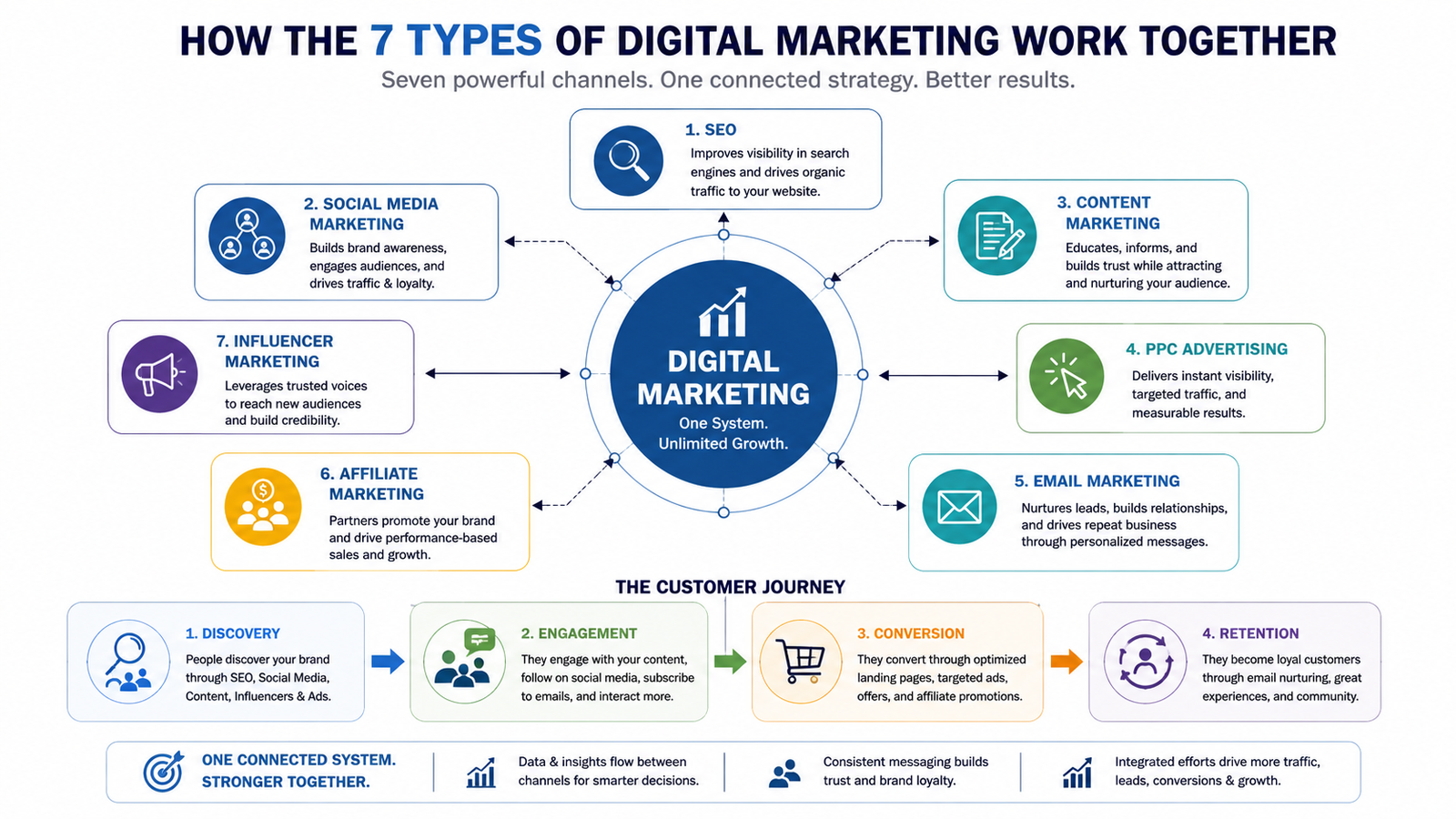
This is one of the most important things beginners should understand.
Digital marketing channels are not completely separate.
For example, imagine you publish a helpful blog article.
Content Marketing
↓
Create a useful article
SEO
↓
Optimize the article so people can discover it through search
Social Media Marketing
↓
Share the article on relevant social platforms
PPC
↓
Promote an important page with paid advertising
Email Marketing
↓
Share the content with subscribers
Influencer Marketing
↓
A relevant creator introduces the content or brand to a new audience
Affiliate Marketing
↓
Partners promote products or services and earn commissions from qualifying referrals
This shows why successful digital marketing is often about creating a connected system rather than treating every channel as a separate activity.
Which Type of Digital Marketing Should a Beginner Learn First?
There is no single answer for everyone.
Your starting point can depend on your interests and career goals.
If you enjoy writing and research:
Start with Content Marketing + SEO
If you enjoy social media and creativity:
Start with Social Media Marketing
If you enjoy numbers, testing, and advertising:
Explore PPC
If you enjoy communication and relationship building:
Explore Email Marketing
If you enjoy product recommendations and online business:
Explore Affiliate Marketing
If you enjoy creators, trends, and collaborations:
Explore Influencer Marketing
For someone building a digital marketing foundation, a practical starting combination is:
SEO + Content Marketing + Social Media
Once you understand these basics, you can gradually explore paid advertising, email, influencer, and affiliate marketing.
Common Mistakes Beginners Should Avoid
Learning digital marketing is not just about knowing different channels. It is also about knowing what not to do.
1. Trying Every Platform at Once
You do not need to be everywhere.
Start with the platforms that match your audience and goals.
2. Focusing Only on Followers
A large follower count does not automatically mean successful marketing.
Look at meaningful metrics such as engagement, traffic, leads, conversions, and revenue where relevant.
3. Creating Content Without a Goal
Every piece of content should have a purpose.
Ask:
What should the audience learn, feel, or do after consuming this content?
4. Ignoring Data
Do not rely only on assumptions.
Use performance data to understand what is working and what needs improvement.
5. Expecting Instant Results
Some channels can produce results quickly, while others require consistent effort and time.
SEO and content marketing, for example, generally require patience and ongoing improvement.
Quick Comparison of the 7 Types
| Type | Main Purpose | Example |
|---|---|---|
| SEO | Organic search visibility | Ranking a blog on Google |
| Social Media Marketing | Awareness & engagement | Instagram campaign |
| Content Marketing | Education & trust | Blog or guide |
| PPC | Paid targeted traffic | Google Ads |
| Email Marketing | Nurturing & retention | Newsletter |
| Affiliate Marketing | Performance-based promotion | Product referral |
| Influencer Marketing | Creator-led reach | Sponsored Reel |
These different digital marketing channels can work together as part of a customer journey. Learn how they fit into a digital marketing funnel in our guide: Digital Marketing Funnel Explained: From Awareness to Conversion.
Final Thoughts
The 7 types of digital marketing discussed in this guide are important building blocks for anyone who wants to understand the digital marketing industry.
SEO helps people discover content through search. Social media helps brands connect with communities. Content marketing provides value. PPC can provide targeted paid visibility. Email marketing helps build direct relationships. Affiliate marketing creates performance-based partnerships, while influencer marketing helps brands reach audiences through trusted creators.
You do not need to master all seven at once.
Start with one or two areas that match your interests, practice them, measure your results, and gradually expand your skills.
The most important lesson for a beginner is simple:
Digital marketing is not about using every channel. It is about using the right channels for the right audience, goal, and stage of the customer journey.
Frequently Asked Questions
What are the 7 types of digital marketing?
The seven types covered in this guide are SEO, Social Media Marketing, Content Marketing, PPC Advertising, Email Marketing, Affiliate Marketing, and Influencer Marketing.
Which type of digital marketing is best for beginners?
There is no single best option. SEO, Content Marketing, and Social Media Marketing are practical starting points because beginners can practice many of their skills with their own website and social profiles.
Is SEO part of digital marketing?
Yes. SEO is one of the major areas of digital marketing and focuses on improving organic visibility in search engines.
Is social media marketing the same as digital marketing?
No. Social media marketing is one part of digital marketing. Digital marketing includes several channels such as SEO, PPC, content, email, affiliate, and influencer marketing.
Do I need to learn all 7 types?
Not immediately. Start with the areas most relevant to your goals and gradually learn additional channels as your skills develop.
Related Articles
Continue learning with LifeHub:
- What Is Digital Marketing? A Beginner’s Guide to Understanding Digital Marketing
- My Learning Journey in Digital Marketing
Explore more beginner-friendly digital marketing guides in the LifeHub Insights section.
[…] There are many areas within digital marketing, but the following seven are some of the most important ones for beginners to understand. 7 Types of Digital Marketing Every Beginner Should Know […]
[…] Initially, these topics felt completely new. But with consistent learning and practice, things started making sense. 7 Types of Digital Marketing Every Beginner Should Know […]
[…] If you want a broader introduction to the major areas of digital marketing, you can also read our guide on 7 Types of Digital Marketing Every Beginner Should Know. […]
[…] choosing your channels, it helps to understand the major forms of digital marketing. Our guide to 7 Types of Digital Marketing Every Beginner Should Know explains the key channels and their role in online […]