


Digital marketing has become an important part of how businesses attract customers, build trust, and generate sales. But simply being active on Instagram, publishing blogs, or running Google Ads does not automatically create results.
The difference often comes down to one thing: strategy.
A good digital marketing strategy gives a business a clear direction. It helps answer simple but important questions: Who are we trying to reach? What do we want to achieve? Which channels should we use? What type of content should we create? And, most importantly, how will we know whether our efforts are working?
This guide explains how to create a practical digital marketing strategy from the ground up—even if you are a beginner and here is my learning journey in digital marketing.
What Is a Digital Marketing Strategy?
A digital marketing strategy is a structured plan that explains how a business will use online channels to reach its target audience and achieve specific business goals.
These channels can include:
- Search engines and SEO
- Social media
- Content marketing
- Email marketing
- Paid advertising
- Websites and landing pages
- Influencer marketing
- Video marketing
The important point is that a strategy is not simply a list of platforms, beginner’s guide to understanding digital marketing.
A business does not need to be everywhere. It needs to be where its audience is most likely to notice, trust, and eventually choose the brand.
This is also why understanding the different forms of digital marketing is important. If you are new to the subject, you can first explore “7 Types of Digital Marketing Every Beginner Should Know” to understand the major channels and how they work.
Why Does a Digital Marketing Strategy Matter?
Without a strategy, digital marketing can quickly become a collection of disconnected activities.
One week a business may post on Instagram, the next it may run an advertisement, and later it may publish a blog—without knowing how any of these activities contribute to the final business goal.
A strategy brings those activities together.
Recent industry data shows just how important digital channels have become. Gartner reported in 2025 that digital channels accounted for 61.1% of total marketing spend among the organizations surveyed.
At the same time, measurement remains a challenge. Nielsen reported that 85% of marketers felt confident about their ability to measure ROI, but only 32% actually measured ROI holistically across traditional and digital media.
The lesson is simple: spending money online is not the same as having a strategy.

How to Create a Digital Marketing Strategy Step by Step
1. Start With a Clear Business Goal
Before choosing a platform or creating content, decide what you actually want to achieve.
Your goal could be:
- Increase website traffic
- Generate leads
- Increase online sales
- Build brand awareness
- Get more enquiries
- Increase repeat customers
- Grow an email list
- Improve customer engagement
A vague goal such as “I want more followers” is difficult to connect to business growth.
Instead, make the goal specific.
For example:
“Increase qualified website enquiries by 20% over the next three months.”
Now your marketing activities have something measurable to work toward.
2. Understand Your Target Audience
A strategy becomes much stronger when you know exactly who you are speaking to.
Ask questions such as:
- Who is my ideal customer?
- What problem are they trying to solve?
- What motivates them to buy?
- What questions do they ask before purchasing?
- Where do they spend time online?
- What prevents them from choosing a product or service?
You can create a simple customer profile including age group, location, interests, needs, pain points, buying behaviour and preferred online platforms.
The goal isn’t to create a complicated persona document. It is to understand the person behind the search, click or purchase.

3. Study Your Competitors
Competitor research can help you understand what is already working in your market.
Look at:
- Their website
- Search rankings
- Social media presence
- Content topics
- Advertising messages
- Offers
- Customer reviews
- Engagement levels
Don’t simply copy what competitors are doing.
Instead, look for opportunities.
Maybe competitors are creating lots of promotional content but very little educational content. That could be your opportunity to become the brand that explains things better.
4. Choose the Right Digital Marketing Channels
One of the biggest mistakes beginners make is trying to use every channel at once.
You don’t need to be everywhere.
Choose channels based on your audience, goals and available resources.
Before choosing your channels, it helps to understand the major forms of digital marketing. Our guide to 7 Types of Digital Marketing Every Beginner Should Know explains the key channels and their role in online marketing.
For example:
SEO: Useful when people actively search for information, products or services.
Social media: Useful for community building, awareness, engagement and visual storytelling.
Content marketing: Useful for educating audiences and building long-term trust.
Email marketing: Useful for nurturing leads and maintaining relationships with existing customers.
Paid advertising: Useful when you want to reach a specific audience and generate results more quickly.
Video marketing: Useful for demonstrations, education, storytelling and awareness.
The best strategy may combine several channels rather than relying on one.
DataReportal’s Digital 2025 research found that no single source introduced brands to more than one-third of adult internet users, reinforcing the value of using a balanced channel mix rather than depending entirely on one source.
5. Create a Content Strategy
Once you know your audience and channels, decide what you are going to communicate.
A strong content strategy should not be based entirely on selling.
Think about four broad content purposes:
Educate
Answer questions your audience is already asking.
Examples:
- How-to guides
- Tutorials
- Beginner guides
- Tips
- FAQs
Build Trust
Show why people should believe in your brand.
Examples:
- Customer stories
- Testimonials
- Case studies
- Behind-the-scenes content
- Expert insights
Engage
Give people a reason to interact with your brand.
Examples:
- Polls
- Questions
- Short videos
- Quizzes
- Interactive posts
Convert
Give interested people a clear next step.
Examples:
- Product pages
- Offers
- Free consultations
- Downloadable resources
- Sign-up forms
This connects directly with the marketing funnel. Your audience may first discover your brand, then become interested, evaluate the offer and finally take action.
If you want to understand this journey in more detail, read “Digital Marketing Funnel: From Awareness to Conversion.”

6. Build a Content Calendar
A content calendar turns your strategy into an actionable plan.
Instead of asking every morning, “What should I post today?”, you can plan your content in advance.
A simple calendar might include:
| Day | Channel | Content | Goal |
|---|---|---|---|
| Monday | Educational Reel | Awareness | |
| Tuesday | Blog | How-to article | SEO |
| Wednesday | Customer story | Trust | |
| Friday | Helpful tip + CTA | Engagement | |
| Saturday | Product/service post | Conversion |
Consistency matters, but consistency does not mean publishing content just for the sake of publishing.
Every piece should have a purpose.
HubSpot’s 2026 marketing statistics compilation reports that website/blog/SEO remains the top ROI-generating channel according to its surveyed marketers, while blog posts were also among the content formats marketers planned to continue investing in.
7. Set a Realistic Budget
A strategy also needs financial planning.
Your budget may include:
- Advertising
- Website development
- SEO tools
- Content creation
- Graphic design
- Video production
- Email marketing software
- Influencer collaborations
You don’t need a huge budget to begin.
A small business can start with a focused strategy, test what works, and gradually increase investment in channels that produce meaningful results.
The key is not simply how much you spend, but where and why you spend it.
8. Define Your Key Performance Indicators (KPIs)
A strategy without measurement is difficult to improve.
Your KPIs should match your objective.
For example:
If your goal is awareness:
- Reach
- Impressions
- Video views
- Brand searches
If your goal is website traffic:
- Organic traffic
- Referral traffic
- Click-through rate
- Engaged sessions
If your goal is lead generation:
- Leads
- Conversion rate
- Cost per lead
- Qualified leads
If your goal is sales:
- Revenue
- Conversion rate
- Customer acquisition cost
- Return on ad spend
Don’t measure every available number.
Measure the numbers that help you make better decisions.
Nielsen’s 2025 research highlights the importance of connecting marketing measurement with actual business outcomes rather than relying only on activity-based metrics.
9. Test, Analyse and Improve
A digital marketing strategy should never be treated as a one-time document.
The online environment changes constantly. Audience behaviour changes, platforms introduce new features, competitors change their messaging and some campaigns perform better than others.
That’s why testing matters.
You can test:
- Headlines
- Images
- Video formats
- CTAs
- Landing pages
- Ad copy
- Posting times
- Audience segments
Then analyse the results and make adjustments.
For example, if one type of Instagram Reel consistently generates more qualified website visits than another, that insight should influence your future content plan.
Strategy → Action → Measurement → Learning → Improvement
That cycle is what turns a basic marketing plan into a working digital marketing strategy.
Common Digital Marketing Strategy Mistakes to Avoid
Even a well-planned strategy can fail if the basics are ignored.
Trying to Be Everywhere
Being active on five platforms is not automatically better than doing two platforms well.
Focusing Only on Followers
Followers can be useful, but they are not the same as customers.
Creating Content Without a Goal
Every piece of content should have a purpose—whether that is awareness, education, engagement, trust or conversion.
Ignoring SEO
Great content is less useful if your audience cannot discover it through search.
Changing Strategy Too Quickly
Not every campaign produces immediate results. Give your strategy enough time to generate meaningful data before making major decisions.
Measuring Vanity Metrics Only
Likes and views can provide useful signals, but they don’t always tell you whether your marketing is contributing to business growth.
A Simple Digital Marketing Strategy Framework
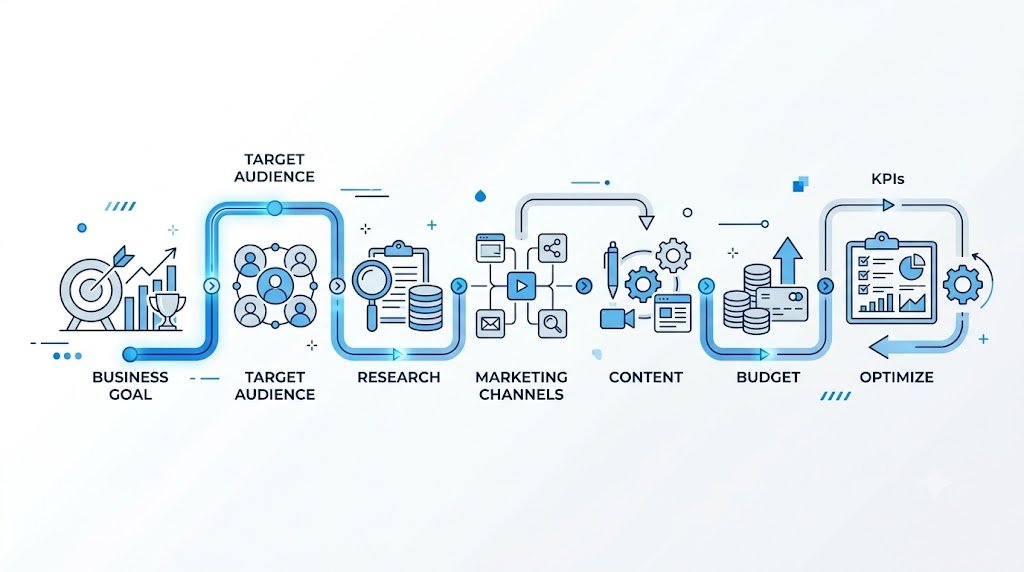
If you’re a beginner, you can remember the process using this simple framework:
GOAL → AUDIENCE → RESEARCH → CHANNELS → CONTENT → BUDGET → KPIs → OPTIMIZE
Start with the business objective.
Then understand your audience.
Research the market and competitors.
Choose the channels that make sense.
Create useful content.
Set your budget.
Measure the right KPIs.
Finally, improve the strategy based on what the data tells you.
Digital Marketing Strategy vs. Digital Marketing Plan
These two terms are often used interchangeably, but there is a small difference.
A strategy explains the overall direction—who you want to reach, what you want to achieve and how you plan to compete.
A plan turns that strategy into specific actions, timelines, campaigns and responsibilities.
Think of it this way:
Strategy = Where are we going and why?
Plan = What exactly are we going to do to get there?
Both are important, but the strategy should come first.
Conclusion
A successful digital marketing strategy doesn’t begin with a social media post or an advertisement.
It begins with understanding the business.
Know your goal. Understand your audience. Study your competitors. Select the right channels. Create useful content. Set realistic budgets and measure the results that actually matter.
Most importantly, remember that digital marketing is not about doing everything at once. It is about making informed decisions and continuously improving them.
The strongest strategies are not necessarily the ones with the biggest budgets. They are the ones with a clear purpose, a well-understood audience and a willingness to learn from real results.
Frequently Asked Questions
1. What is a digital marketing strategy?
A digital marketing strategy is a structured approach for using online channels such as SEO, social media, content, email and paid advertising to achieve specific business goals.
2. How do I create a digital marketing strategy for my business?
Start by defining your business goal, identifying your target audience, researching competitors, selecting suitable channels, creating a content plan, setting a budget and deciding which KPIs you will use to measure success.
3. Which digital marketing channel is best for a business?
There is no single best channel for every business. The right choice depends on your audience, business model, objectives, budget and customer journey.
4. How long does it take for a digital marketing strategy to work?
It depends on the channel and objective. SEO and content marketing can take time to build momentum, while paid advertising may generate data and traffic more quickly. Consistent measurement is important before making major decisions.
5. What are the most important digital marketing KPIs?
Important KPIs can include website traffic, leads, conversion rate, customer acquisition cost, revenue and return on marketing investment. The right KPI depends on the business goal.
6. Do small businesses need a digital marketing strategy?
Yes. In fact, a clear strategy can help small businesses avoid wasting limited time and budget on channels that do not reach their target audience.
7. Should a business use multiple digital marketing channels?
Often, yes—but selectively. A combination of channels can help a business reach customers at different stages of their journey. The goal is to choose channels that complement each other rather than simply using as many platforms as possible.