

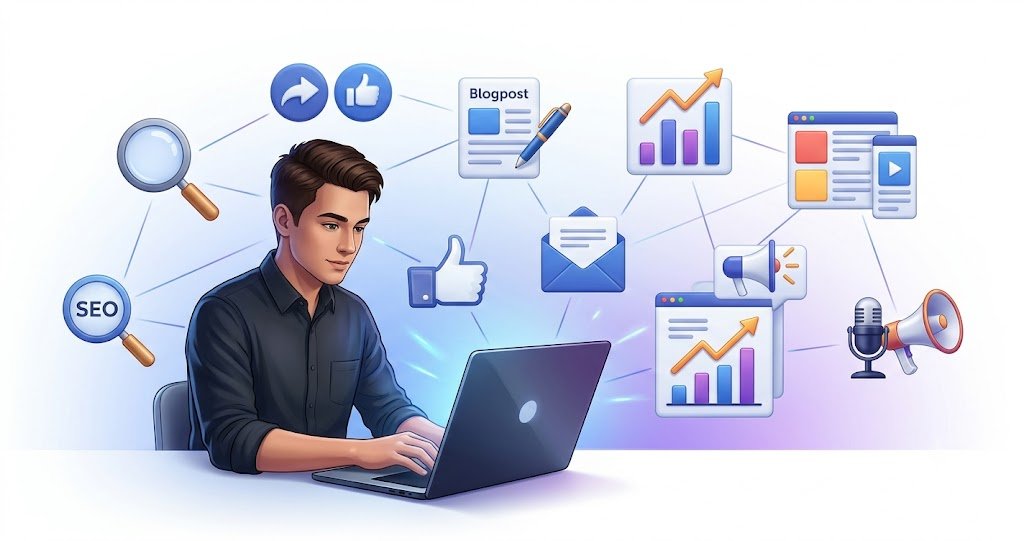
Today, whenever we open Instagram, search something on Google, watch a YouTube video, read an email, or even visit an online store, we are interacting with digital marketing in some way.
But what exactly is digital marketing?
When I first started learning digital marketing, I honestly thought it was mostly about social media posts, Instagram reels, and advertisements. As I explored the field, I realised that digital marketing is much bigger than that. It combines SEO, content, social media, paid advertising, email marketing, analytics, audience research, and strategy to help businesses reach the right people online.
This article is based on that beginner perspective. If you are completely new to digital marketing and want to understand what it actually means, how it works, its major types, and how you can start learning it, this guide will give you a clear starting point.
What Is Digital Marketing?
Digital marketing is the process of promoting products, services, brands, or businesses through digital channels and technologies.
Instead of depending only on traditional methods such as newspapers, television, radio, posters, or physical advertisements, digital marketing allows businesses to connect with people through platforms such as:
- Search engines like Google
- Social media platforms
- Websites and blogs
- YouTube
- Online advertisements
- Mobile applications
- Influencer platforms
For example, imagine you search Google for “best running shoes for beginners.”
You may see:
- A blog explaining different running shoes
- A product page
- A Google advertisement
- A YouTube video
- Social media content related to running
All of these can be part of a digital marketing strategy.
The important thing I learned while exploring digital marketing is that it is not just about posting content online. The real goal is to reach the right audience, provide value, build trust, and eventually encourage people to take an action.
That action could be:
- Visiting a website
- Following a social media account
- Signing up for an email
- Downloading an app
- Making a purchase
- Contacting a business
Why Is Digital Marketing Important?
The internet has changed the way people discover information, compare products, communicate with businesses, and make purchasing decisions.
A business can now reach potential customers without depending entirely on a physical location.
For example, a small online business can create a website, publish useful content, build a social media presence, and use online advertising to reach people in different cities or even different countries.
Digital marketing is important because it allows businesses to:
Reach a Wider Audience
Traditional advertising can sometimes be limited by location. Digital platforms allow businesses to reach people beyond their immediate geographical area.
Target Specific Audiences
Digital advertising platforms can allow marketers to target audiences based on factors such as interests, demographics, behaviour, or online activity.
Measure Results
One of the biggest advantages of digital marketing is measurement.
Marketers can analyse metrics such as:
- Website traffic
- Clicks
- Engagement
- Leads
- Conversions
- Ad performance
- Email open rates
This helps businesses understand what is working and what needs improvement.
Build Long-Term Relationships
Digital marketing is not always about getting an immediate sale.
A useful blog post, helpful Instagram page, informative YouTube channel, or email newsletter can gradually build trust with an audience.
How Digital Marketing Works
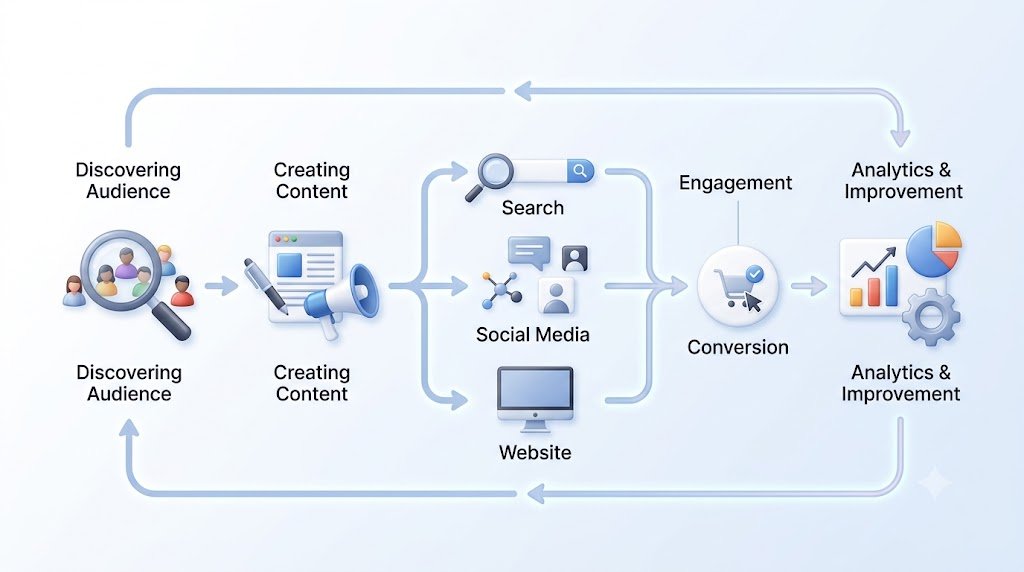
Digital marketing usually works as a connected process rather than as separate activities.
A simple way to understand it is:
Audience → Content → Reach → Engagement → Conversion → Analysis → Improvement
Let’s understand this with a simple example.
Suppose a company sells handmade skincare products.
First, the company needs to understand its target audience.
Who are they?
Perhaps they are people interested in natural skincare.
The company can then create useful content such as:
- Skincare tips
- Ingredient guides
- Product demonstrations
- Blog articles
- Instagram Reels
- Customer reviews
SEO can help people discover the company’s website through search engines.
Social media can help the company build awareness and engagement.
Paid advertisements can help reach a more targeted audience.
Email marketing can help maintain relationships with existing customers.
Analytics can show which activities are generating the best results.
This is why digital marketing is better understood as an overall strategy, not a collection of random online activities.
Digital marketing doesn’t work as a single step. People usually move through different stages before taking action. To understand this process, explore our guide to the Digital Marketing Funnel : From Awareness to Conversion
7 Major Types of Digital Marketing
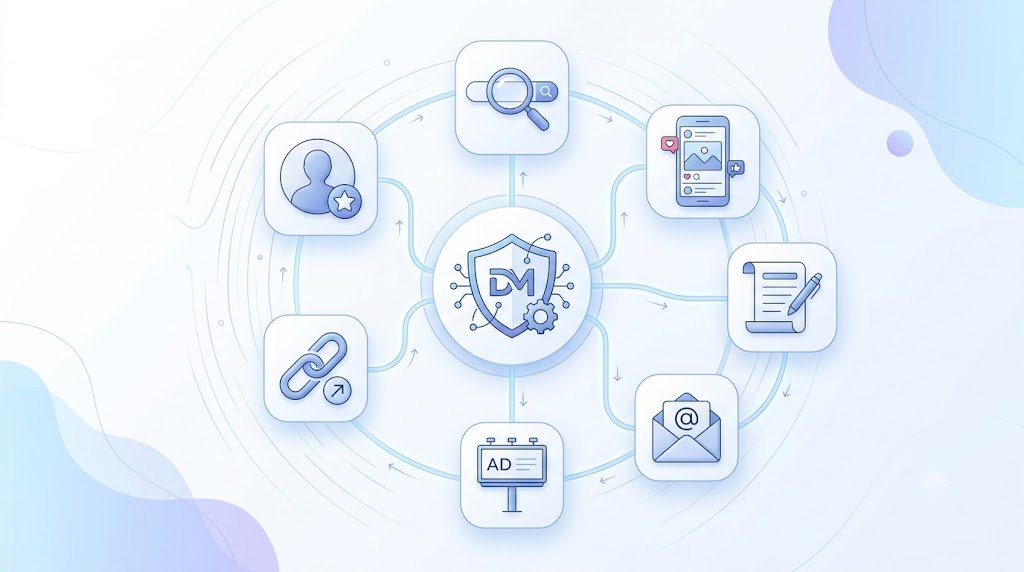
There are many areas within digital marketing, but the following seven are some of the most important ones for beginners to understand. 7 Types of Digital Marketing Every Beginner Should Know
1. SEO — Search Engine Optimization
SEO stands for Search Engine Optimization.
It is the process of improving online content and websites so that they have a better chance of appearing in relevant search engine results.
For example, if you search:
“How to learn digital marketing”
you may find articles, videos, courses, and websites explaining the topic.
Businesses use SEO to increase their visibility when people search for topics related to their products or services.
SEO can involve:
- Keyword research
- On-page SEO
- Technical SEO
- Internal linking
- Content optimization
- Website structure
- Backlinks
One thing I found interesting while learning SEO is that it is not simply about adding keywords everywhere. Search intent and useful content matter too.
2. Social Media Marketing
Social media marketing involves using platforms such as Instagram, Facebook, LinkedIn, YouTube, and other social platforms to communicate with an audience and promote a brand, product, service, or idea.
Examples include:
- Instagram Reels
- LinkedIn posts
- YouTube videos
- Facebook posts
- Stories
- Community engagement
- Social media campaigns
Social media marketing can help brands build awareness and create direct communication with their audience.
However, simply posting every day does not automatically mean a social media strategy is working.
A good strategy considers:
Audience + Content + Platform + Timing + Engagement + Analytics
3. Content Marketing
Content marketing focuses on creating and distributing useful and relevant content to attract and retain an audience.
Content can include:
- Blog posts
- Videos
- Infographics
- E-books
- Guides
- Social media posts
- Podcasts
- Case studies
For example, a fitness website could publish an article titled:
“Beginner’s Guide to Starting a Home Workout.”
The article provides useful information while also bringing potential visitors to the website.
This is where I started understanding an important idea: good marketing does not always begin by selling something. Sometimes it begins by helping someone.
4. Email Marketing
Email marketing involves communicating with an audience through email.
Businesses can use email to:
- Share newsletters
- Announce new products
- Send offers
- Welcome new subscribers
- Share useful content
- Maintain customer relationships
For example, if someone subscribes to a website’s newsletter, the business might send them a weekly email containing useful articles and updates.
Email marketing can be particularly useful because it allows businesses to communicate directly with people who have already shown interest in their brand.
5. Search Engine Marketing
Search Engine Marketing, commonly associated with paid search advertising, involves promoting websites through advertisements on search engines.
For example, when you search for a product on Google, some results may appear as sponsored advertisements.
Businesses can use paid search campaigns to appear in front of people who are actively searching for particular products, services, or information.
This differs from SEO because SEO primarily focuses on earning organic visibility, while paid search involves paying for advertising placement.
6. Affiliate Marketing
Affiliate marketing is a performance-based marketing model.
In simple terms, an affiliate promotes another company’s product or service using a special tracking link.
If someone purchases through that link, the affiliate may receive a commission according to the program’s terms.
For example, a content creator might review a laptop and include an affiliate link where viewers can learn more or purchase it.
Affiliate marketing is common in:
- Blogs
- YouTube channels
- Product review websites
- Social media content
7. Influencer Marketing
Influencer marketing involves collaborating with people who have an established audience and influence within a particular niche.
For example, a skincare brand may collaborate with a beauty creator to demonstrate one of its products.
Influencer marketing can work because audiences may already trust and follow the creator.
However, choosing an influencer should not be based only on follower count. Audience relevance, engagement, credibility, and content quality can be equally important.
Digital Marketing vs Traditional Marketing
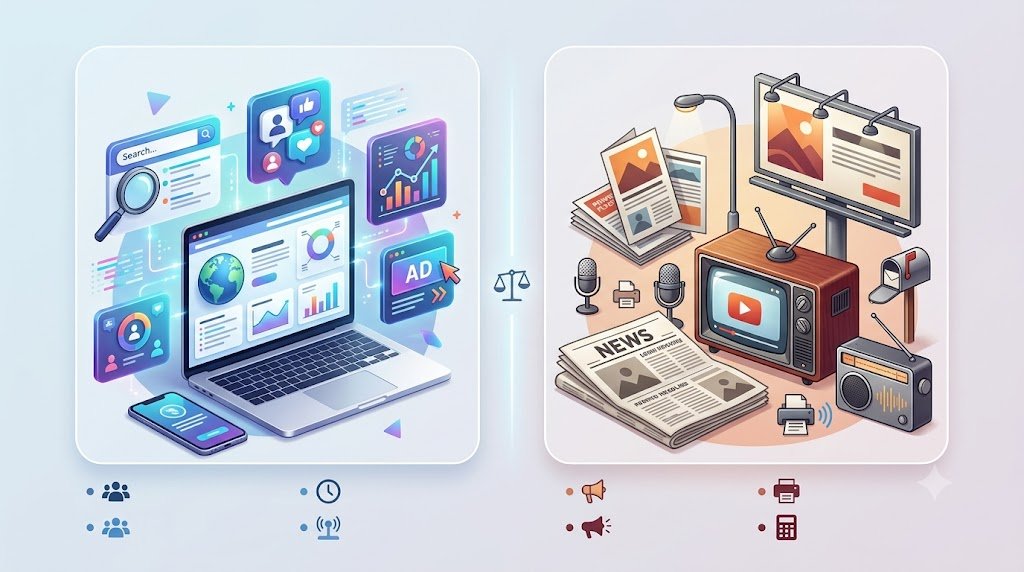
Both digital and traditional marketing have the same basic objective: to reach an audience and promote a product, service, or brand.
The major difference is the medium used.
| Digital Marketing | Traditional Marketing |
|---|---|
| Websites | Newspapers |
| Social media | Television |
| Search engines | Radio |
| Magazines | |
| Online advertisements | Billboards |
| Blogs and videos | Posters |
| Digital analytics | Traditional audience measurement |
Digital marketing often provides more detailed performance data.
For example, with an online advertisement, marketers can analyse clicks, impressions, conversions, and other performance metrics.
Traditional marketing can still be useful, especially for local businesses and large-scale awareness campaigns.
So it is not necessarily about digital marketing replacing traditional marketing. The best approach depends on the business, audience, goals, and budget.
Benefits of Digital Marketing
Digital marketing offers several benefits to businesses and creators.
1. Global Reach
A business can potentially reach customers outside its local area.
2. Better Audience Targeting
Online campaigns can be targeted toward specific audiences.
3. Measurable Performance
Digital platforms provide data that can help marketers evaluate campaigns.
4. Flexible Budgeting
Businesses can choose different advertising and content strategies according to their budget.
5. Faster Communication
Brands can communicate with customers through social media, email, websites, and messaging platforms.
6. Brand Building
Consistent digital content can help businesses develop a recognizable online identity.
7. Personalization
Digital channels can allow businesses to provide more relevant messages and experiences to different audiences.
Examples of Digital Marketing
Digital marketing is easier to understand when we look at everyday examples.
Example 1: Instagram Reel
A clothing brand publishes a Reel showing different ways to style one outfit.
Type: Social Media Marketing + Content Marketing
Example 2: Google Search Result
A website publishes an article targeting the search query:
“Best budget smartphones for students.”
Type: SEO + Content Marketing
Example 3: Sponsored Google Advertisement
A company pays to appear when users search for a relevant product.
Type: Search Engine Marketing
Example 4: Promotional Email
An online store sends subscribers an email about its latest collection.
Type: Email Marketing
Example 5: YouTube Product Review
A creator reviews a product and provides a tracked purchasing link.
Type: Influencer Marketing + Affiliate Marketing
These examples show why different areas of digital marketing often work together.
Skills Needed to Start a Digital Marketing Career
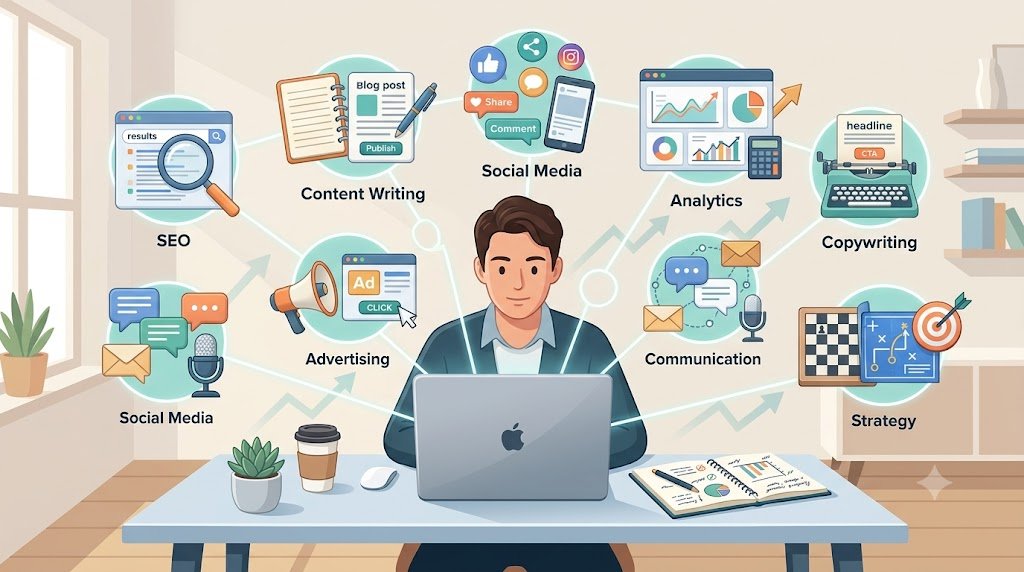
You do not need to master everything before starting.
However, developing a combination of technical, creative, analytical, and communication skills can be useful.
Some important skills include:
SEO Basics
Understand keywords, search intent, on-page SEO, technical basics, and content optimization.
Content Creation
Learn how to create useful written, visual, and video content.
Social Media Management
Understand platforms, audiences, content formats, engagement, and analytics.
Analytics
Learn how to read performance data and identify what is working.
Copywriting
Learn how to write headlines, captions, advertisements, emails, and calls-to-action.
Paid Advertising Basics
Understand the fundamentals of online advertising and campaign objectives.
Communication
Marketing involves communicating ideas clearly to customers, teams, and clients.
Strategic Thinking
A marketer needs to understand why a campaign is being created, not just how to create it.
How Beginners Can Start Learning Digital Marketing
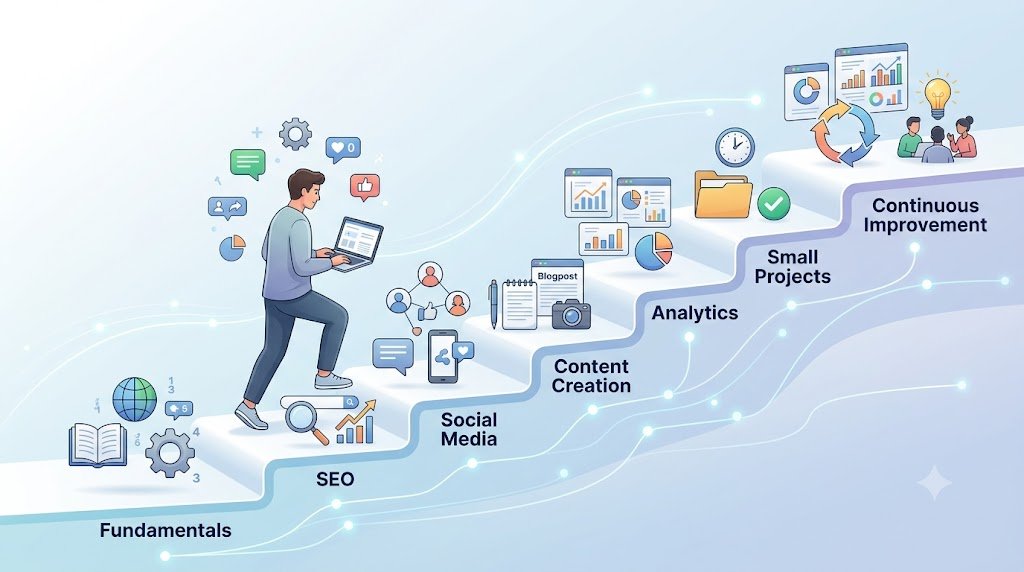
If you are a beginner, trying to learn every topic at once can become confusing.
A better approach is to learn step by step.
Step 1: Understand the Fundamentals
Start by learning what digital marketing is and how its different components work together.
Step 2: Learn SEO Basics
Understand keywords, search intent, on-page SEO, and content optimization.
Step 3: Explore Social Media Marketing
Learn how different platforms work and why the same content may perform differently on different platforms.
Step 4: Start Creating Content
Do not only watch tutorials.
Create something.
For example:
- Write a blog
- Create an Instagram post
- Make a short video
- Design an infographic
- Build a simple content calendar
Step 5: Learn Analytics
Once you start creating content, look at the results.
Ask:
What worked? Why did it work? What can I improve?
Step 6: Build Small Projects
Projects can help turn theoretical knowledge into practical experience.
For example, you could create a small website and practise:
- SEO
- Blog writing
- Internal linking
- Content planning
- Social media promotion
- Basic analytics
Step 7: Keep Experimenting
Digital marketing keeps changing.
Therefore, learning should not stop after completing a course.
My Experience Learning Digital Marketing
When I started learning digital marketing, I initially thought it was mainly about social media.
I assumed that knowing how to create Instagram posts, captions, hashtags, and Reels would be enough.
But as I explored the subject further, I realised that digital marketing is much broader.
I started discovering how SEO, content marketing, social media, paid advertising, email marketing, analytics, audience research, and strategy are connected.
One of the biggest lessons for me was that marketing is not simply about creating content.
It is about understanding:
Who is the audience?
What problem do they have?
What information are they looking for?
Which platform can reach them?
What type of content will be useful to them?
How will we measure the result?
This changed the way I looked at digital marketing.
Instead of thinking, “What should I post today?”, I started thinking, “Why am I creating this content, who is it for, and what do I want it to achieve?”
That shift from just creating content to thinking strategically is one of the most valuable things I have learned so far.
I am still learning and exploring different areas of digital marketing, but this journey has helped me understand that digital marketing is not one single skill. It is a combination of skills that work together.
Frequently Asked Questions
Is digital marketing difficult for beginners?
Digital marketing can feel overwhelming at first because it includes many different areas. However, beginners can learn it step by step instead of trying to master everything at once.
Do I need a technical background to learn digital marketing?
No. A technical background is not mandatory. Basic computer skills, communication, creativity, curiosity, and willingness to learn can provide a good starting point.
How long does it take to learn digital marketing?
There is no fixed time because digital marketing includes many skills. You can learn the fundamentals in a few months, but becoming highly skilled requires continuous practice and experience.
Which digital marketing skill should a beginner learn first?
Start with the fundamentals and then explore areas such as SEO, content marketing, social media, analytics, and paid advertising.
Is SEO part of digital marketing?
Yes. SEO is one of the major areas of digital marketing.
Can I learn digital marketing for free?
Yes. There are many free educational resources, blogs, videos, documentation, and practice opportunities available online.
Can digital marketing be a career?
Yes. Digital marketing can lead to roles such as SEO specialist, social media manager, content marketer, digital marketing executive, PPC specialist, email marketer, and digital marketing strategist.
Do I need a certificate to start a digital marketing career?
A certificate can demonstrate that you have completed a course, but practical knowledge and projects are also important. Being able to show what you can actually do can make your profile stronger.
Conclusion
Digital marketing is much more than posting on social media.
It is a combination of SEO, content, social media, paid advertising, email, analytics, audience research, and strategy that helps businesses connect with people online.
For beginners, the most important thing is not trying to learn everything immediately.
Start with the fundamentals, choose one area to explore, practise what you learn, create small projects, analyse your results, and gradually expand your knowledge.
My own learning journey started with the simple idea that digital marketing was mainly about social media. But the more I explored it, the more I understood that every part of digital marketing connects to a larger strategy.
And that is what makes digital marketing interesting: there is always something new to learn, test, analyse, and improve. My Learning Journey in Digital Marketing.
[…] For me, practical projects, experimentation, personal experience, and trying things myself became just as important as theory. A Beginner’s Guide to Understanding Digital Marketing […]
[…] What Is Digital Marketing? A Beginner’s Guide to Understanding Digital Marketing […]
[…] Understanding the funnel helps marketers create the right message for the right person at the right stage instead of showing the same content to everyone. If you’re new to digital marketing, you can first understand the basics in our beginner’s guide to digital marketing […]
[…] The important point is that a strategy is not simply a list of platforms, beginner’s guide to understanding digital marketing. […]